
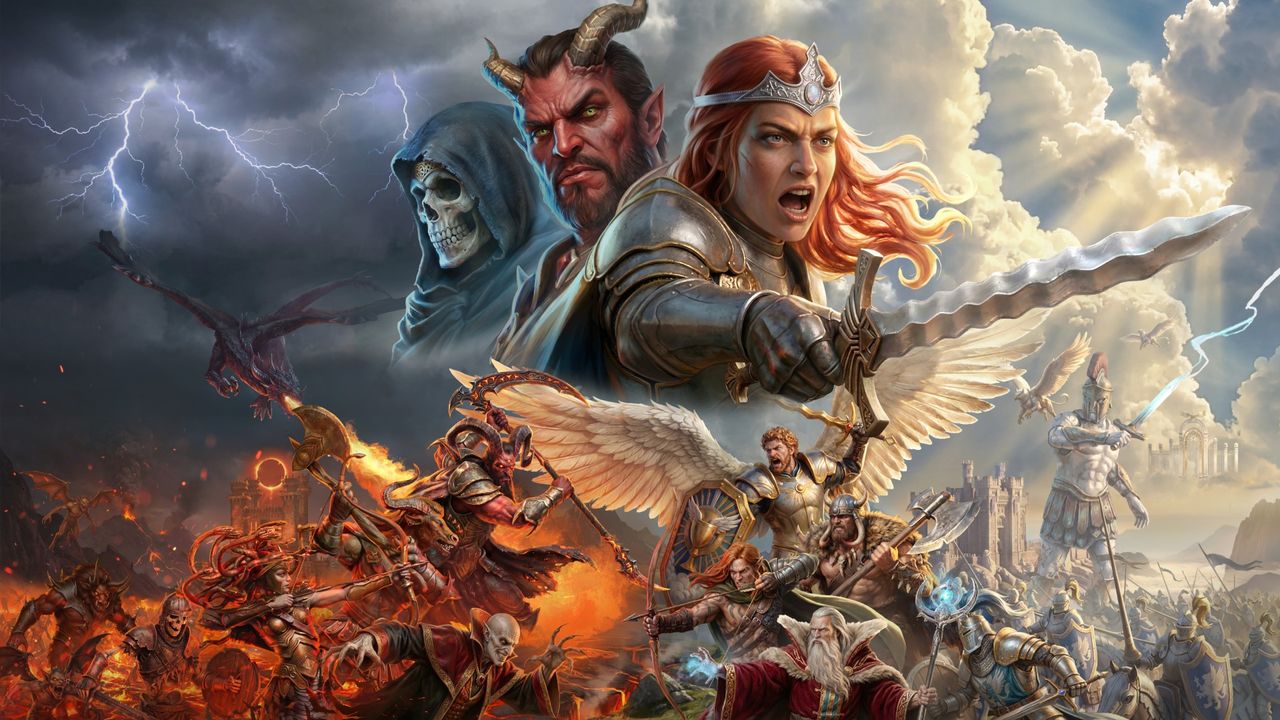
My empire in Heroes of Might and Magic 3 Remake collapses with all the grace of a dizzy donkey stumbling off a cliff. Like many of history’s greatest civilizations, the cause of its downfall is a tale as old as time itself: a necromancer commanding five ghost dragons. In my defense, this marks my first foray into the legendary Heroes of Might and Magic 3 — I was merely two years old when the original launched in 1999. My interest in experiencing this remake lies less in evaluating its authenticity to the source material and more in understanding how it measures up against my usual rotation of strategy games, which includes titles like Total War: Warhammer 3, XCOM, and virtually any other turn-based tactical experience I can get my hands on. The excellent news is that Heroes of Might and Magic 3 Remake slips into that prestigious pantheon like an overqualified deity claiming their rightful throne.
Just a few hours with the game, including a brief story-driven prologue and a sandbox-style match on the reimagined map called Arrogance 2026, proves sufficient to convince me that my two-year-old self should have been grinding this game from day one. The original Heroes of Might and Magic 3, developed by New World Computing and published by 3DO Company, released in February 1999 and quickly became one of the most beloved turn-based strategy games ever created. It spawned multiple expansions, including Armageddon’s Blade and The Shadow of Death, and cultivated a passionate community that has kept the game alive for over 25 years through mods, fan patches, and dedicated servers.
A Hero’s Welcome to Strategic Warfare
Your time in Heroes of Might and Magic 3 Remake divides itself elegantly between two distinct gameplay phases: exploring an overworld map where each turn represents a single day, and engaging rival heroes and their armies in intense turn-based hexagonal combat. Cities scattered across the map can be conquered and claimed, securing their valuable resources while allowing you to recruit from their unique denizen pools. A fiery hovel buried deep underground makes for an excellent source of demons and infernal creatures, while a gleaming tower perched high in the mountains can be repurposed to churn out powerful golems and magical constructs. This variety in unit recruitment creates strategic depth that rewards thoughtful expansion and territorial control.
Building a formidable army requires patience and careful resource management. Recruitment buildings within your cities determine which fighters — and how many of each type — are drawn to your banner each week. This weekly recruitment cap serves as an elegant feature for both gameplay balance and narrative immersion, preventing players from simply snapping their fingers to instantly replenish troops after suffering heavy casualties in a close battle. When rival hero Thorgrim lands his army on my shores with hostile intent, I marshal my biggest concentration of pikemen, archers, and majestic griffins to intercept him. The ensuing battle becomes an absolute slugfest, and although I emerge victorious, my surviving forces remain tattered and bloodied. In retrospect, I suspect I should have exercised more patience and waited for a more decisive advantage before picking that particular fight.
Mastering the Art of Tactical Combat
Despite my only prior experience with the HoMM franchise being a brief hour dabbling in Heroes of Might and Magic: Olden Era, the series’ core systems prove remarkably straightforward to learn while offering tremendous depth to master. Attack and movement indicators make battlefield positioning easy to understand at a glance, and my fundamental tactics quickly evolve into bogging down enemy melee forces with expendable pikemen while my ranged archers and swift-flying Archangels systematically eliminate their vulnerable backlines. The unit stacking mechanic adds fascinating strategic considerations — multiple units can be consolidated into a single hex, with their combined strength reflected in aggregate health and damage output.
One hex can theoretically hold hundreds of pikemen that attack as a single cohesive force, but their low individual health means a devastating attack from something like a ghost dragon can kill dozens in a single devastating swoop. Conversely, larger and more powerful individual units like ghost dragons are considerably hardier, requiring concentrated fire from multiple sources to bring down. When I finally amass sufficient troops to march on Thorgrim’s fortified tower across the sea, eliminating just one of his massive Titans requires my hero to sling lightning bolts while siege engines and archers relentlessly pelt the construct with arrows. This layered combat system, originally designed in the late 1990s, still feels remarkably fresh and engaging in its modern incarnation.
The Underground Depths Spell Doom
Everything proceeds smoothly in my campaign right up until the moment I uncover a mysterious gateway leading underground — revealing an entirely separate layer of the map to explore and conquer. However, not much fighting remains to be done once the depths reveal their secrets. I recruit a necromancer hero and dispatch her to explore the subterranean realm, hoping to discover weaker units that can be slain and subsequently raised as undead minions. Instead, she encounters a far more powerful necromancer commanding five — yes, five — ghost dragons. My hero melts like fat off bone under their withering assault, and with the rest of my forces deployed far away fighting Thorgrim’s remaining strongholds, and all recruitment pools depleted from recent mobilization efforts, my cities stand completely defenseless.
My preview session concludes just as the gateway begins spilling its undead contents onto the surface world. The writing glows ominously on the wall — within a few more in-game days, nothing but ash and spectral scales would remain where my civilization once proudly stood. This dramatic reversal of fortune perfectly encapsulates what makes the Heroes of Might and Magic series so compelling: careful strategic planning can unravel in moments when unexpected threats emerge from unexplored territory. The remake preserves this tension beautifully while modernizing the visual presentation and user interface for contemporary audiences.
A Timeless Classic Reborn for Modern Audiences
Coming into HoMM 3 Remake completely blind, I find myself utterly hooked on its high-fantasy flavor and no-frills strategic gameplay. However, certain changes are specifically designed to delight long-time fans who have cherished this game for decades. The technology powering HoMM 3 Remake proves capable of replicating existing and community-made maps from the 1999 original, transforming their charming 20th-century graininess into lush modern visuals without sacrificing each tile’s core functionality. Quality of life improvements like attack previews and streamlined interface elements make the experience more accessible without dumbing down the strategic complexity.
It represents a welcome surprise to see HoMM 3 receive this new lease on life so soon after the runaway success of Heroes of Might and Magic: Olden Era, which demonstrated continued appetite for this style of gameplay. With the series’ core mechanics proving remarkably timeless even after 25 years, HoMM 3 Remake seems poised to bring countless new fans into the fold — myself enthusiastically included among them. For strategy enthusiasts who somehow missed this classic during its original era, the remake offers an ideal entry point into one of gaming’s most beloved franchises.
Expert Opinion: The Heroes of Might and Magic 3 Remake represents a masterclass in how to revitalize a beloved classic without alienating its dedicated fanbase. By preserving the original’s strategic depth while modernizing its presentation and implementing community-requested quality of life improvements, Ubisoft has positioned this title to capture both nostalgic veterans and curious newcomers. Given the recent success of Olden Era and the enduring passion of the HoMM community, this remake could potentially spark a broader renaissance for turn-based strategy games in the mainstream market.