
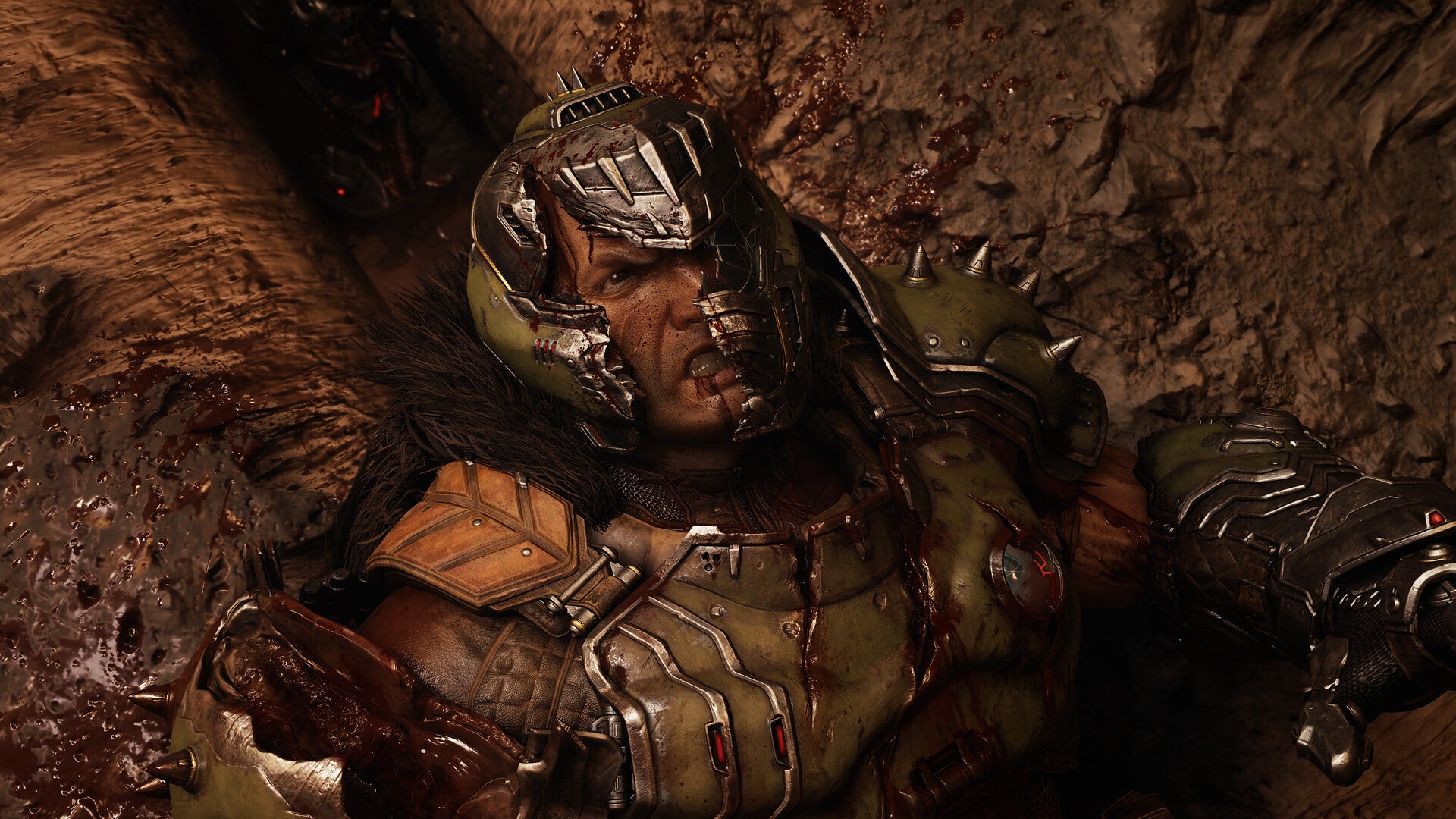
A senior developer at legendary game studio id Software has delivered a scathing critique of Microsoft and Xbox leadership following devastating layoffs that cut the Doom developer’s workforce in half. Chris Hays, lead services programmer at id Software and a 15-year veteran of the studio, publicly condemned the decision to eliminate 136 staff members, declaring that Microsoft executives “fundamentally don’t understand art” and questioning whether the company grasps how video games are actually made.
Hays, speaking candidly on the German podcast “Auf ein Bier” with host Andre Peschke, painted a bleak picture of the studio’s current state and expressed profound skepticism about its ability to maintain the quality that made id Software a household name among gamers. His comments represent one of the most direct public criticisms of Microsoft’s gaming division from an active employee at one of its subsidiary studios.
A Studio Cut in Half Cannot Produce AAA Games
Hays was unequivocal about the impact of the layoffs on id Software’s capacity to deliver the caliber of games that defined its recent renaissance. “It’s hard to make a game that is AAA, that’s like we’ve done before, with half the people. And by hard, I mean impossible,” he stated bluntly. The programmer emphasized that entire departments essential to game development had been “gutted,” with whole disciplines eliminated from the studio’s roster.
The criticism strikes at the heart of how video game development actually functions. Modern AAA game production requires intricate coordination between dozens of specialized teams — programmers, artists, animators, sound designers, quality assurance testers, and many others. When key links in this chain are severed, the entire production pipeline can grind to a halt or produce inferior results. Hays underscored this point by noting that if Microsoft has a plan for how the reduced studio will operate effectively, that information has not been shared with the remaining employees.
“The reassurances that we’re still the same id and we’re still going to do things, well, first of all, we’re not the same id. We’re half the same id,” Hays continued. “id was the people. What made us special was the people and the relationships we have.” This sentiment echoes a fundamental truth in creative industries: institutional knowledge, team chemistry, and collaborative relationships built over years cannot be easily replaced or reconstructed.
The Legacy of id Software and the Doom Franchise
id Software holds a unique position in gaming history as one of the most influential developers ever to emerge from the industry. Founded in 1991 by John Carmack, John Romero, Tom Hall, and Adrian Carmack, the studio essentially invented the first-person shooter genre with titles like Wolfenstein 3D and the original Doom. These games didn’t just entertain millions; they established gameplay mechanics and technical standards that continue to influence game development three decades later.
After a period of relative decline in the late 2000s, id Software experienced a dramatic resurgence with 2016’s Doom reboot, which earned widespread critical acclaim for its visceral combat and faithful modernization of the classic formula. The studio continued this momentum with 2020’s Doom Eternal and most recently with 2025’s Doom: The Dark Ages, which IGN awarded a 9/10 score in its review. The studio also released its Revelations DLC just last month, demonstrating continued productivity — at least until the layoffs struck.
However, Hays pointed out a crucial detail that undermines the company’s official messaging. When id Software issued a statement following the layoffs, it claimed the restructuring left the studio “about the same size we were when making Doom 2016.” According to Hays, this is not accurate. “The reality is that id now houses less than the number of staff that worked on Doom 2016,” he explained, raising an uncomfortable question: “Are we going to make something equivalent to a single-player Xbox 360 game? Because that’s the size of the studio we have.”
The Game Pass Problem and Microsoft’s Business Model
Hays’s criticism extended beyond the layoffs themselves to question Microsoft’s entire approach to the gaming business, particularly its flagship Xbox Game Pass subscription service. He suggested that the subscription model may be creating fundamental accounting problems that obscure the true success of individual games. “Whenever we see the Microsoft financial reports that say there were poor sales under Bethesda. What’s a sale if you have Game Pass?” he asked rhetorically.
This observation touches on a significant debate within the gaming industry. Traditional game sales provide clear metrics: units sold, revenue generated, return on investment. But subscription services complicate this calculus considerably. When millions of subscribers can access a new release at no additional cost, how do executives measure that game’s individual contribution to the company’s success? And more importantly for developers, how do they justify continued investment in expensive AAA production when the direct revenue connection becomes murky?
“You’re not doing a game-sold business model. They fundamentally don’t understand art. They don’t. They don’t understand art. They don’t understand games. They don’t understand that business model,” Hays declared. His frustration reflects a growing tension between creative developers who see games as artistic endeavors requiring substantial investment and corporate executives who may view them primarily as content to drive subscription numbers.
Xbox’s Largest Restructuring in History
The layoffs at id Software represent just a fraction of a much larger upheaval at Xbox. The July cuts were part of what new Xbox CEO Asha Sharma described as the “most significant restructure in Xbox history.” The initiative immediately affected 1,600 employees on the day of its announcement, with an additional 1,600 positions scheduled for elimination throughout the current financial year — a staggering total of 3,200 jobs.
This massive restructuring comes after Microsoft’s acquisition of ZeniMax Media, id Software’s parent company, in a $7.5 billion deal completed in 2021. That acquisition brought beloved studios including Bethesda Game Studios, Arkane, and MachineGames under the Xbox umbrella, along with valuable franchises like The Elder Scrolls, Fallout, and Doom. Critics have questioned whether Microsoft is properly stewarding these creative assets or simply strip-mining them for short-term financial gains.
Hays noted that communication from management has been tightly controlled, with “studio management given talking points on things that are allowed to be said and what is not allowed to be said.” He interpreted the corporate messaging as an attempt to prevent panic and additional departures. “They don’t want more people to jump ship and say, ‘Oh, there’s no more future in id, so we’re all going to leave,’ and then there’s no one left. They don’t want unrest.”
Reflecting on the differences between Microsoft’s management and the previous ZeniMax ownership, Hays expressed nostalgia for a more straightforward system of accountability. Under ZeniMax, success was measured primarily by critical acclaim and meeting sales expectations, with clear responsibility assigned when either metric fell short. “That is obviously not how Microsoft is operating,” he said. “It doesn’t make any sense.” As id Software attempts to chart a path forward with drastically reduced resources, Hays’s public criticism serves as a stark reminder of the human cost behind corporate restructuring decisions — and raises serious questions about whether Microsoft’s gaming division can maintain the creative excellence that made its acquired studios valuable in the first place.
Expert Opinion: The situation at id Software exemplifies a troubling pattern in the gaming industry where subscription-based business models clash with the resource-intensive nature of AAA game development. Microsoft’s approach appears to prioritize short-term cost reduction over long-term creative capacity, potentially sacrificing the very talent and institutional knowledge that made studios like id Software worth acquiring. If these trends continue, we may see a significant decline in the quality of output from Microsoft’s gaming division within the next two to three development cycles.