
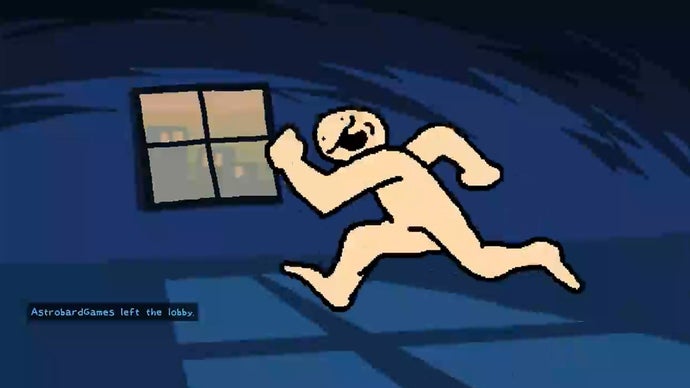
Anyone who has spent significant time playing competitive online games knows the frustration all too well: you’re in the middle of an intense match, perhaps even winning, when suddenly one of your opponents vanishes into the digital ether. The dreaded rage quit has struck again, leaving remaining players feeling cheated out of a fair competition and a satisfying conclusion. This phenomenon has plagued online gaming communities for decades, creating toxic environments and diminishing the overall experience for everyone involved. However, one creative indie game developer is taking a refreshingly humorous approach to this age-old problem, working on an innovative solution that could transform moments of frustration into opportunities for laughter.
The developer’s concept addresses rage quitting not through punishment or penalties, but through comedy. Instead of simply leaving an empty space or replacing the disconnected player with a basic AI, the system creates amusing scenarios that acknowledge the quit while entertaining those who remain. This approach recognizes that while rage quitting cannot be entirely prevented, the reaction to it can be controlled and even turned into a positive experience. Early reactions from the gaming community have been overwhelmingly enthusiastic, with many players expressing excitement about a solution that prioritizes fun over frustration.
The Long History of Rage Quitting in Online Gaming
Rage quitting has been a persistent issue since the earliest days of online multiplayer gaming. The phenomenon dates back to the dial-up era of the 1990s, when players discovered they could simply disconnect their modems to escape unfavorable matches in games like Quake and StarCraft. As online gaming evolved through Xbox Live, PlayStation Network, and PC platforms like Steam, so too did the sophistication of rage quitting. Players learned to pull ethernet cables, force-close applications, and exploit various technical loopholes to exit matches without formal penalties. Game developers have tried numerous approaches to combat this behavior over the years, from temporary bans and matchmaking penalties to public shame through leaver statistics displayed on player profiles.
Despite these efforts, rage quitting remains remarkably common across virtually every competitive online game. Studies and player surveys have consistently shown that a significant percentage of online matches are affected by early disconnections, whether due to genuine technical issues or deliberate abandonment. Games like League of Legends, Rocket League, and fighting games like Street Fighter have implemented increasingly sophisticated systems to detect and penalize intentional disconnects, yet the behavior persists. The psychological roots of rage quitting run deep, tied to competitive frustration, fear of losing ranking points, and the anonymity that online gaming provides. Some researchers have even suggested that the lack of face-to-face consequences makes abandoning matches feel more acceptable to players who would never walk away from a board game with friends.
A Creative Approach to an Eternal Problem
What makes this indie developer’s approach particularly noteworthy is its fundamental philosophy shift away from punishment toward entertainment. Traditional anti-rage-quit measures operate on deterrence, attempting to make leaving so costly that players will endure unfavorable matches. However, these systems often fail because frustrated players are already in an emotional state where long-term consequences feel irrelevant. By contrast, creating humorous in-game reactions to disconnects serves multiple purposes simultaneously. It provides entertainment value to remaining players, potentially reduces the negative emotional impact of being abandoned, and creates memorable moments that can even be shared on social media platforms.
The indie gaming scene has long been a breeding ground for innovative solutions to industry-wide problems. Independent developers, unburdened by corporate risk aversion and focus-group testing, frequently pioneer concepts that larger studios later adopt. This particular project joins a growing list of indie innovations that prioritize player psychology and community health. The gaming industry has increasingly recognized that technical solutions alone cannot solve behavioral problems, and approaches that address the emotional and social dimensions of multiplayer gaming are gaining traction. Industry analysts suggest that creative solutions like this one could influence how major developers approach similar challenges in AAA titles, potentially reshaping multiplayer gaming culture in meaningful ways.
The Future of Fair Play in Online Gaming
As online gaming continues to grow into a multi-billion dollar industry with hundreds of millions of active players worldwide, the importance of maintaining healthy competitive environments cannot be overstated. Rage quitting represents just one facet of the broader challenge of fostering positive player behavior in anonymous online spaces. Solutions that transform negative experiences into positive ones, rather than simply punishing bad behavior, may represent an evolution in how the gaming industry thinks about community management. While it remains to be seen whether this particular indie project will achieve widespread adoption or inspire imitators, it has already succeeded in sparking important conversations about creative approaches to persistent problems. The gaming community’s enthusiastic response suggests a real appetite for solutions that bring more joy and less frustration to competitive play, and developers who can deliver on that promise may find eager audiences waiting.
Expert Opinion: This innovative approach signals a potential paradigm shift in how the gaming industry addresses toxic behaviors. Rather than escalating punishment systems that can alienate player bases, humor-based solutions leverage positive psychology to maintain engagement while acknowledging the reality of human frustration. If successful, we may see major publishers incorporating similar mechanics, fundamentally changing how multiplayer games handle disconnections and potentially reducing overall toxicity through unexpected joy rather than expected penalties.