
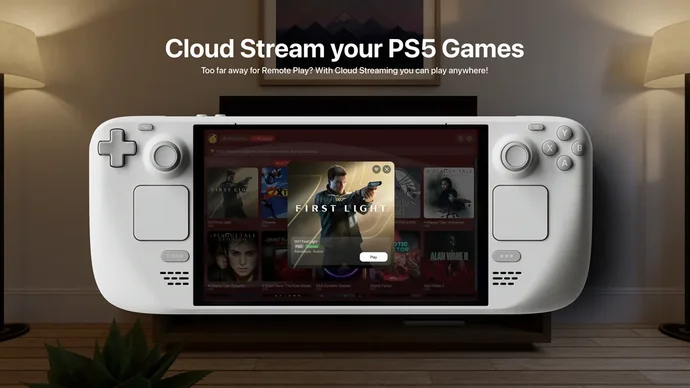
In a significant development for portable gaming enthusiasts, a new cloud-streaming application has entered public testing that enables Steam Deck and Steam Machine owners to stream PlayStation games directly to their devices without requiring a PlayStation 5 console. This breakthrough effectively transforms Valve’s popular handheld gaming PC into a versatile platform capable of accessing Sony’s gaming library, potentially reshaping how players interact with PlayStation content across different hardware ecosystems.
The application, which has just opened its playtest phase to interested users, represents a notable shift in the gaming landscape where platform exclusivity has traditionally kept players locked into specific hardware purchases. Until now, streaming PlayStation games remotely required either owning a PS5 console for Remote Play functionality or purchasing the dedicated PlayStation Portal handheld device, which retails for approximately $199. This new solution bypasses both requirements entirely, leveraging cloud infrastructure to deliver PlayStation experiences directly to compatible devices.
How the Technology Works
The cloud-streaming approach differs fundamentally from Sony’s own Remote Play feature, which streams games from a user’s personal console to another device over a local network or internet connection. Instead, this new application connects users to remote servers running PlayStation software, similar to how services like Xbox Cloud Gaming and NVIDIA GeForce NOW operate. Players with active PlayStation Plus subscriptions can potentially access hundreds of titles from the service’s streaming catalog without any local PlayStation hardware.
PlayStation Plus Premium subscribers already have access to cloud streaming as part of their membership benefits, which costs $17.99 per month or $159.99 annually. The service includes a rotating library of classic PlayStation titles from the PS1, PS2, and PSP eras, alongside more recent PS4 and PS5 games. By enabling this functionality on Steam Deck, the new application essentially unlocks this existing benefit for use on Valve’s hardware platform.
Implications for the Gaming Market
The Steam Deck has sold millions of units since its launch in February 2022, establishing itself as one of the most successful PC gaming handhelds in history. Running on a modified version of Linux called SteamOS, the device was designed primarily for playing PC games from Valve’s Steam platform. However, its open nature has allowed enthusiasts to install Windows, run emulators, and access various streaming services not officially supported by Valve. This flexibility has made it an attractive option for gamers seeking a versatile portable device rather than a single-purpose console.
Industry analysts suggest that tools enabling cross-platform access could pressure console manufacturers to reconsider their traditional business models. Sony has already begun releasing first-party titles on PC, with games like God of War, Horizon Zero Dawn, and Spider-Man achieving commercial success on Steam. The ability to stream PlayStation content to competing hardware could accelerate this trend toward platform agnosticism, though it also raises questions about how Sony will respond to unofficial solutions that potentially undermine their hardware sales strategy.
What This Means for Players
For gamers considering their options, this development offers an intriguing alternative to purchasing dedicated PlayStation hardware. A Steam Deck starts at $399 for the base model and provides access to thousands of PC games in addition to now potentially streaming PlayStation content. Combined with services like Xbox Cloud Gaming, which already functions on the device through browser-based solutions, the Steam Deck increasingly positions itself as a universal gaming platform capable of spanning multiple ecosystems.
The playtest phase will help developers identify technical issues and optimize performance before a wider release. Participants can expect to provide feedback on streaming quality, input latency, connection stability, and overall user experience. As cloud gaming technology continues to mature, with improved compression algorithms and expanding server infrastructure, the viability of streaming-based gaming solutions will likely continue to improve, potentially changing how future generations of players access their favorite titles.
Expert Opinion: This development signals a broader industry shift toward hardware-agnostic gaming experiences, where subscription services and cloud infrastructure matter more than physical console ownership. While Sony is unlikely to officially endorse third-party streaming solutions, the market pressure from such innovations may accelerate their own cross-platform initiatives. Within the next five years, we could see major publishers prioritizing service subscriptions over hardware sales as their primary revenue model.